
Commencing Form (Raise Hands) 起勢
Qǐ shì
How to do it
Slowly float both arms forward and up to shoulder height as if lifted by water, wrists leading. Settle the elbows, draw the hands toward the chest, then press down as the knees bend and the body sinks.
Step by step
- From Wuji, turn the palms to face behind you
- Inhale as both arms float forward and up to shoulder height, wrists leading, fingers soft
- Drop the elbows so the forearms draw slightly back toward the body
- Exhale as the palms press down to hip level while the knees bend and the body sinks
Breathing
Inhale as the arms rise; exhale as they press down and the body sinks.
Health focus
Shoulder mobility, gentle leg strengthening, coordinating breath and movement.
Common mistakes
- Raising the shoulders with the arms
- Lifting the arms above shoulder height
- Bending at the waist instead of the knees when sinking
Martial meaning
Rising hands can lift an opponent's arms; pressing down roots and neutralizes an upward push.
How it varies between styles
| Chen | Hands rise with a slight spiral and the whole body sinks lower; often followed immediately by Buddha's Warrior Attendant. |
|---|---|
| Yang | Even, gentle rise to shoulder height, press down to hip level. |
| Wu | Smaller rise; feet stay parallel. |
| Sun | Hands rise to chest then push forward and separate in open–close. |
| Seated | Same arm motion while seated; exhale as hands lower. |
Where it appears
- Simplified 24 (Beijing Form) – step 1: Commencing Form
- Yang Family Traditional 103 Form – step 2: Beginning
- Cheng Man-ch'ing 37-Posture Short Form – step 2: Beginning
- Wu Jianquan 108 Long Form – step 1: Begin Tai Chi Form
- Sun Style 73 Competition Form – step 1: Wuji Becomes Taiji (Commencement)
Animated 2D guide (front view). The highlighted leg carries the weight, the faint trails show the path of the hands, and the cue at the top suggests the breath.
Video demonstrations 影片
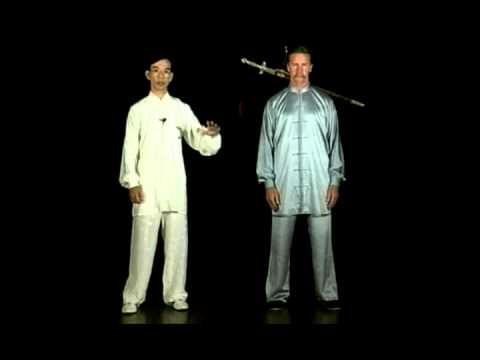

Videos belong to the channels named and are shared for education. Figures In Space is not affiliated with them.
Move slowly, keep the knees soft and over the toes, and stay within a comfortable range. Every movement can be adapted for a chair.