Qigong sets 氣功
The classic health-qigong sets of Traditional Chinese Medicine. Each movement links to its organ focus and a seated adaptation. Hover to see the movement.
Three regulations 三調
Regulate the body (posture), the breath (slow, deep, even) and the mind (calm intention). Qigong is suitable for nearly every level of mobility and is easily practised seated.
Baduanjin – Eight Pieces of Brocade 八段錦
The most popular qigong set in the world. Eight simple movements, each linked in TCM to organs and meridians. Takes about 12 minutes; easy to learn; fully adaptable to seated practice. Origin: Song dynasty (c.1100s); Health Qigong Association standard 2003
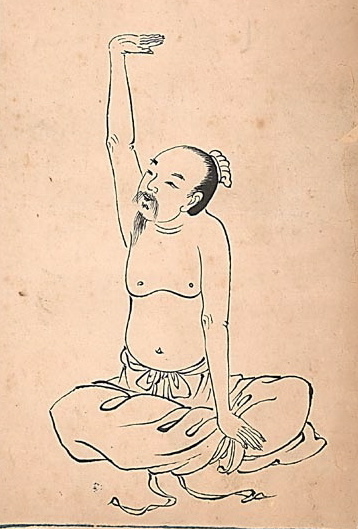
- 1.Two Hands Hold Up the HeavensRegulates the San Jiao (Triple Burner) – the body's three cavities.
- 2.Drawing the Bow to Shoot the EagleOpens the chest; Lung and Heart; strengthens legs.
- 3.Separate Heaven and EarthSpleen and Stomach – digestion.
- 4.Wise Owl Gazes BackwardRelieves the 'five strains and seven injuries'; neck and eyes.
- 5.Sway the Head and Shake the TailClears 'heart fire' – calms anxiety.
- 6.Two Hands Hold the Feet to Strengthen the KidneysKidneys and lower back.
- 7.Clench the Fists and Glare FiercelyLiver – strength and vitality.
- 8.Bouncing on the ToesDisperses illness; circulation.
Taiji Qigong Shibashi (18 Movements) 太極氣功十八式
Eighteen flowing tai-chi-based breathing movements done in place – a perfect first class for seniors and community centers. Origin: Lin Housheng, Shanghai, 1979 – based on Yang tai chi
- 1.Commencing – Raising the ArmsWhole-body circulation and calm breathing.
- 2.Opening the ChestWhole-body circulation and calm breathing.
- 3.Painting a RainbowWhole-body circulation and calm breathing.
- 4.Separating CloudsWhole-body circulation and calm breathing.
- 5.Rolling Arms (Repulse Monkey in place)Whole-body circulation and calm breathing.
- 6.Rowing the BoatWhole-body circulation and calm breathing.
- 7.Lifting the BallWhole-body circulation and calm breathing.
- 8.Turning to Gaze at the MoonWhole-body circulation and calm breathing.
- 9.Turning Waist and Pushing PalmWhole-body circulation and calm breathing.
- 10.Cloud Hands in Horse StanceWhole-body circulation and calm breathing.
- 11.Scooping the Sea, Looking at the SkyWhole-body circulation and calm breathing.
- 12.Pushing WavesWhole-body circulation and calm breathing.
- 13.Flying Pigeon Spreads Its WingsWhole-body circulation and calm breathing.
- 14.Punching in Horse StanceWhole-body circulation and calm breathing.
- 15.Flying Wild GooseWhole-body circulation and calm breathing.
- 16.Rotating the WheelWhole-body circulation and calm breathing.
- 17.Bouncing the BallWhole-body circulation and calm breathing.
- 18.Pressing Palms – Balancing QiWhole-body circulation and calm breathing.


Wuqinxi – Five Animal Frolics 五禽戲
Imitating tiger, deer, bear, monkey and crane – one of the oldest recorded health exercise systems in China, created by a doctor. Origin: Attributed to physician Hua Tuo (c.140–208 CE)
- 1.Tiger PlayLiver; spine flexibility.
- 2.Deer PlayKidneys; lower back.
- 3.Bear PlaySpleen and Stomach; digestion.
- 4.Monkey PlayHeart; agility and coordination.
- 5.Crane (Bird) PlayLungs; balance.
Follow along 影片

Videos belong to the channels named and are shared for education. Figures In Space is not affiliated with them.
Liuzijue – Six Healing Sounds 六字訣
Breathing exercise pairing six sounds with the Five Organs plus the Triple Burner. Gentle enough for any mobility level. Origin: Described by Tao Hongjing (456–536 CE)
- 1.Healing Sound Xu (嘘) – LiverLiver; eyes; anger→kindness
- 2.Healing Sound He (呵) – HeartHeart; impatience→joy
- 3.Healing Sound Hu (呼) – SpleenSpleen; worry→openness
- 4.Healing Sound Si (呬) – LungsLungs; grief→courage
- 5.Healing Sound Chui (吹) – KidneysKidneys; fear→gentleness
- 6.Healing Sound Xi (嘻) – Triple BurnerSan Jiao; balance of all organs
Follow along 影片

Videos belong to the channels named and are shared for education. Figures In Space is not affiliated with them.
Yijinjing – Muscle/Tendon Change Classic 易筋經
Twelve strengthening-stretching postures associated with the Shaolin Temple and Bodhidharma legend. Origin: Shaolin tradition; earliest texts c.1624
- 1.Wei Tuo Presents the Pestle 1Tendons and sinews; whole-body vitality (Shaolin tradition attributed to Bodhidharma).
- 2.Wei Tuo Presents the Pestle 2Tendons and sinews; whole-body vitality (Shaolin tradition attributed to Bodhidharma).
- 3.Wei Tuo Presents the Pestle 3Tendons and sinews; whole-body vitality (Shaolin tradition attributed to Bodhidharma).
- 4.Plucking a Star and Exchanging a ConstellationTendons and sinews; whole-body vitality (Shaolin tradition attributed to Bodhidharma).
- 5.Pulling Nine Oxen by Their TailsTendons and sinews; whole-body vitality (Shaolin tradition attributed to Bodhidharma).
- 6.Showing Talons and Spreading WingsTendons and sinews; whole-body vitality (Shaolin tradition attributed to Bodhidharma).
- 7.Nine Ghosts Drawing SabresTendons and sinews; whole-body vitality (Shaolin tradition attributed to Bodhidharma).
- 8.Sinking the Body Three TimesTendons and sinews; whole-body vitality (Shaolin tradition attributed to Bodhidharma).
- 9.Black Dragon Displays Its ClawsTendons and sinews; whole-body vitality (Shaolin tradition attributed to Bodhidharma).
- 10.Tiger Springing on Its PreyTendons and sinews; whole-body vitality (Shaolin tradition attributed to Bodhidharma).
- 11.Bowing Down to Strike the DrumTendons and sinews; whole-body vitality (Shaolin tradition attributed to Bodhidharma).
- 12.Swinging the TailTendons and sinews; whole-body vitality (Shaolin tradition attributed to Bodhidharma).

